Realism Series
Sector:
Fine Art Drawing
Location:
London, UK
Year:
2021




Materials:
Description:
1. The Isolated Series — Joy?
This portrait explores the uncertainty of joy during periods of isolation. The subject’s exaggerated smile captures a moment where negativity appears to drift away, but the title questions whether that happiness is genuine, temporary, or performed. As part of The Isolated Series, the piece reflects on the fragility of happiness and the human need to hold onto moments of lightness, even when loneliness remains in the background.
Medium: Pencil on canvas paper.
2. The Isolated Series — Greed
This piece explores how isolation can come from within. The portrait presents a character shaped by wealth, status, and self-interest, suggesting that greed can become a source of emotional distance. Through the figure’s expression and formal appearance, the work reflects on how material ambition can separate someone from genuine connection.
Medium: Pencil on canvas paper.
3. The Isolated Series — Masking
This drawing looks at the idea of masking and code-switching — the way people perform different versions of themselves depending on the space they are in. The figure’s staged pose gives the piece a performative quality, reflecting how identity can become something acted out rather than fully lived. Beneath the surface, the work questions how social masks can protect us while also creating another form of isolation.
Medium: Pencil on canvas paper.
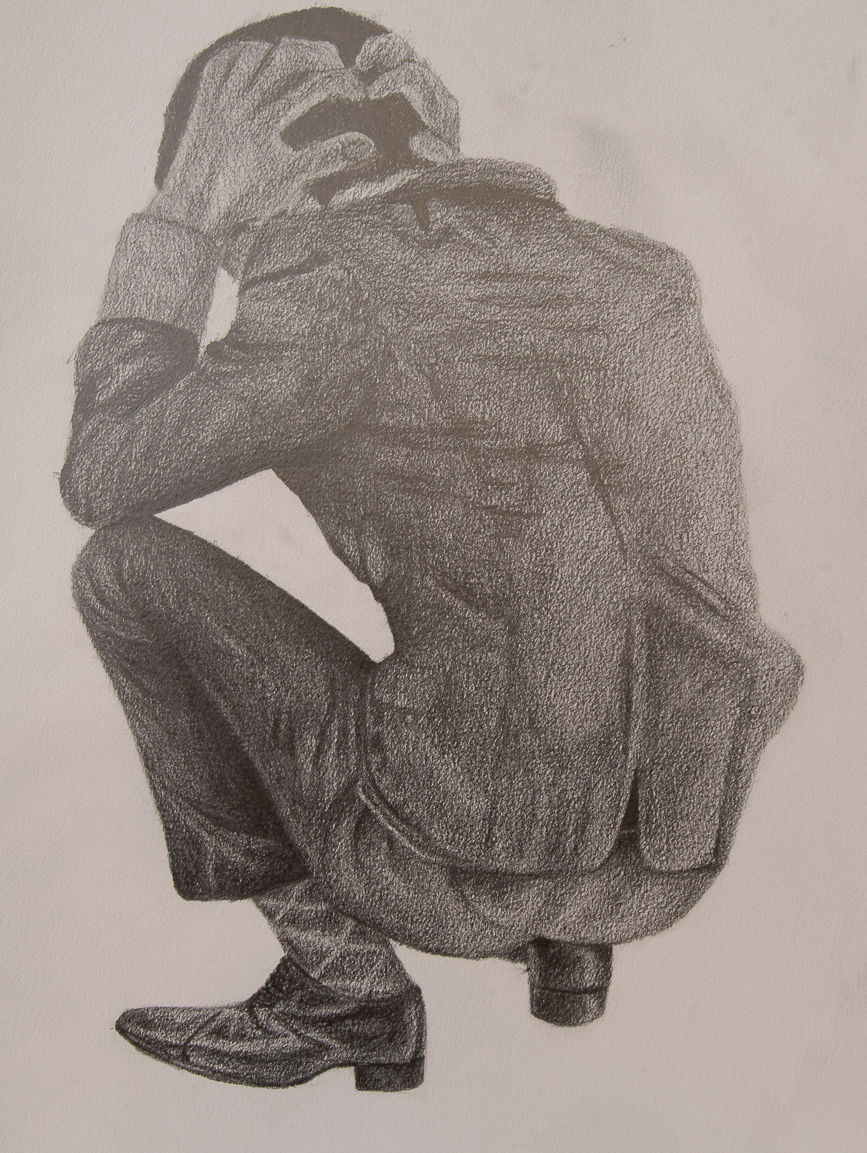
4. The Isolated Series — Frustration
This portrait captures a moment of internal pressure. The crouched posture and covered face suggest emotional build-up, silence, and the feeling of having no clear outlet. As part of The Isolated Series, the piece reflects on how isolation can intensify frustration, turning it inward and making it harder to express.
Medium: Pencil on canvas paper.
5. Hypodermic Needle Theory — Study I
This portrait study was created as part of my research into Harold Lasswell’s Hypodermic Needle Theory, which explores how media can directly influence public perception. The image focuses on how people, particularly vulnerable subjects, are framed within news and charity imagery. Through pencil portraiture, the piece questions how visual media can guide empathy and shape the way audiences interpret others.
Medium: Pencil on canvas paper.
6. Hypodermic Needle Theory — Study II
This drawing continues my exploration of media influence and emotional response. The portrait focuses on expression, gaze, and vulnerability, considering how documentary-style imagery can create sympathy while also reinforcing certain narratives. The work uses realism to make the viewer reflect on the power of images and how they can affect public understanding.
Medium: Pencil on canvas paper.
7. Hypodermic Needle Theory — Study III
This piece explores how media images can construct fear, urgency, or judgement through the way a subject is presented. Connected to the Hypodermic Needle Theory, the drawing questions how repeated visual messaging can influence perception before the viewer has time to form an independent opinion. The covered face and tense imagery create a more confronting portrait, reflecting the relationship between representation, narrative, and public reaction.
Medium: Pencil on canvas paper.